Lifecycle of Data

A data lifecycle is the sequence of stages that a particular unit of data goes through from its creation to its eventual disposal at the end of its useful life.

Lifecycle

  1. Acquire: Data are created or collected.
  2. Store: Data are stored in a location that is both secure and easily accessible for management and analysis.
  3. AggregateData in disparate datasets are combined in Dartmouth's data warehouse and other aggregation tools to create larger datasets which are greater than the sum of its parts.
  4. Analyze: Data are examined and transformed to extract information and discover new insights.
  5. Use: Dartmouth community members apply the insights gained from data analysis toward making decisions, affecting change, or delivering a product or service.
  6. Share: Data Stewards connect Data Users to the data they need and provide data insights to organizational leadership.
  7. Dispose: Based on applicable retention schedules, data are removed from Dartmouth servers, applications, databases, and other locations to prevent future release or use.

Data Governance and Records Management

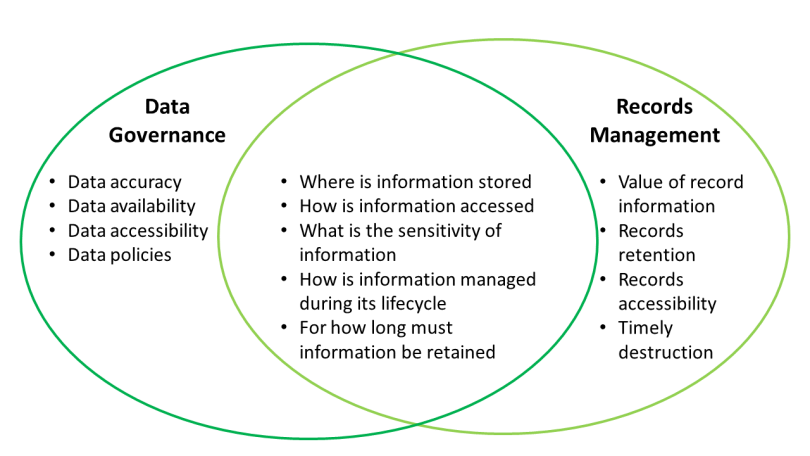
Data and records are two converging information assets that share governance goals driven by statutes, regulations, and policies.  Aptly named, Data Governance and Records Management share the joint interests of preservation, retrievability/accessibility, integrity, security, and quality of data and records respectively.

Furthermore, Data Governance and Records Management are responsible for documenting within their policy frameworks:

  • Where data/records are stored
  • How data/records are being accessed and by whom
  • The sensitivity of  data/records
  • How to manage data/records throughout their lifecycle
  • How long must data/records be retained
dg_and_rm.png

Intersection of Data Governance and Records Management includes where information is stored, managed, and accessed.